







Modernizing a digital banking platform with [i]Claude Code[/i]
An AI-accelerated modernization approach helped DCI modernize a 30 year old banking platform while maintaining accountability, traceability, and control.




Modernizing an established mobile banking application meant preserving 20 years of [i]business logic[/i] while building trust in AI.
Modernizing an established mobile banking application meant preserving 20 years of [i]business logic[/i] while building trust in AI.
Modernizing an established mobile banking application meant preserving 20 years of [i]business logic[/i] while building trust in AI.
Modernizing an established mobile banking application meant preserving 20 years of [i]business logic[/i] while building trust in AI.
Modernizing an established mobile banking application meant preserving 20 years of [i]business logic[/i] while building trust in AI.
DCI wanted to modernize its GoBanking platform with an AI-enabled process that preserved business rules, held to bank-grade governance, and could be adopted by its own engineers beyond the proof of concept.
Established Platform
Established Platform
Established Platform
Established Platform
Established Platform
Built on ASP.NET WebForms and WCF, the application supported multiple account experiences that had to be preserved during modernization.
Market-Leading Customer Experience
Market-Leading Customer Experience
Market-Leading Customer Experience
Market-Leading Customer Experience
Market-Leading Customer Experience
DCI wanted GoBanking to keep up with customer expectations and continue to be a modern, market-leading experience.
Embedded Business Logic
Embedded Business Logic
Embedded Business Logic
Embedded Business Logic
Embedded Business Logic
Three decades of account rules, workflows, and customer experiences living inside legacy code.
Operational Constraints
Operational Constraints
Operational Constraints
Operational Constraints
Operational Constraints
Work performed within DCI's Windows RDP environment, with no customer data permitted to leave the secure environment.
AI Trust Gap
AI Trust Gap
AI Trust Gap
AI Trust Gap
AI Trust Gap
AI prompting lacked the consistency and accountability required for regulated software delivery.
Design-to-Dev Handoff
Design-to-Dev Handoff
Design-to-Dev Handoff
Design-to-Dev Handoff
Design-to-Dev Handoff
Prior efforts handed engineers static designs to rebuild in code by hand, adding rework and design QA cycles.
Success depended on an AI-accelerated modernization process that preserved business logic, met governance requirements, and [i]earned engineers' trust.[/i]
Success depended on an AI-accelerated modernization process that preserved business logic, met governance requirements, and [i]earned engineers' trust.[/i]
Success depended on an AI-accelerated modernization process that preserved business logic, met governance requirements, and [i]earned engineers' trust.[/i]
Success depended on an AI-accelerated modernization process that preserved business logic, met governance requirements, and [i]earned engineers' trust.[/i]
Success depended on an AI-accelerated modernization process that preserved business logic, met governance requirements, and [i]earned engineers' trust.[/i]
Targeted Modernization
Targeted Modernization
Targeted Modernization
Targeted Modernization
Targeted Modernization
Modernize specific banking features to validate the approach before expanding to additional experiences.
Structured AI Workflows
Structured AI Workflows
Structured AI Workflows
Structured AI Workflows
Structured AI Workflows
Claude Code worked from approved specifications instead of open-ended prompts, producing more consistent implementation.
Governed AI Modernization
Governed AI Modernization
Governed AI Modernization
Governed AI Modernization
Governed AI Modernization
AI operated inside a governed workflow with engineering review and test gates.
Shared Specifications
Shared Specifications
Shared Specifications
Shared Specifications
Shared Specifications
Product, design, engineering, and testing worked from the same validated specifications.
Elevated User Experience
Elevated User Experience
Elevated User Experience
Elevated User Experience
Elevated User Experience
AI accelerated quality design with specifications flowing directly into implementation, reducing translation and rework.
End-to-end Traceability
End-to-end Traceability
End-to-end Traceability
End-to-end Traceability
End-to-end Traceability
Every decision connects requirements, implementation, and testing.
Human Accountability
Human Accountability
Human Accountability
Human Accountability
Human Accountability
Engineers review, validate, and approve changes.
Repeatable Delivery
Repeatable Delivery
Repeatable Delivery
Repeatable Delivery
Repeatable Delivery
A documented workflow teams can reuse across future modernization efforts.
Versioned Repo Artifacts
Versioned Repo Artifacts
Versioned Repo Artifacts
Versioned Repo Artifacts
Versioned Repo Artifacts
Workflow shipped as a plugin marketplace in Azure DevOps and per-repo CLAUDE.md instruction files, code-reviewed alongside the codebase.
Zero Data Egress
Zero Data Egress
Zero Data Egress
Zero Data Egress
Zero Data Egress
On-premises execution: no codebase content, prompts, or session data left the bank's network.
Business Rule Traceability
Business Rule Traceability
Business Rule Traceability
Business Rule Traceability
Business Rule Traceability
Every change tied to a cited Business Rule ID (BR-NNN), traceable at the rule level.
Gated Pull Requests
Gated Pull Requests
Gated Pull Requests
Gated Pull Requests
Gated Pull Requests
Every change shipped as a pull request gated by passing tests and an engineer reviewing the AI-generated diff before merge.

For DCI, AI is about giving our people better tools to serve our clients and modernize how we work. We believe technology should support human expertise, not replace it. Praxent helped us build AI workflows that give our teams room to move faster while keeping the human judgment, oversight, and accountability our clients expect.

Governance is built into [i]the design tool.[/i]
Governance is built into [i]the design tool.[/i]
Governance is built into [i]the design tool.[/i]
Governance is built into [i]the design tool.[/i]
Governance is built into [i]the design tool.[/i]
Before human review, the generator enforces a fixed set of rules.
Generation guardrails, enforced at source
Generation guardrails, enforced at source
Generation guardrails, enforced at source
Generation guardrails, enforced at source
Generation guardrails, enforced at source
No real PII in sample data. No external scripts or third-party libraries. No real form endpoints. No hardcoded credentials. No dark patterns. No brand impersonation.
Every screen clears these checks at the first draft, so for a regulated bank, compliance starts before review, not after.
We know an engagement is working when designers and engineers build from the same specifications and the translation between design and code falls away. That is where the trust comes from: the team reviews working software at every step.

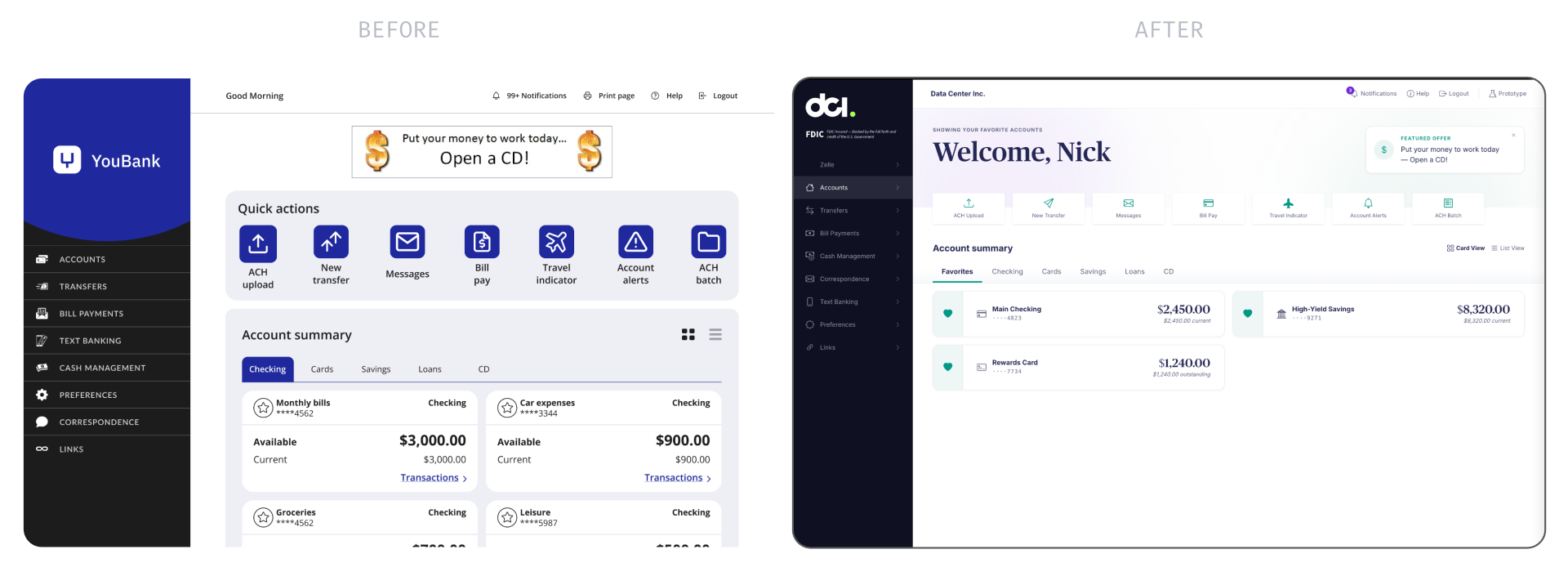
Account Summary
Account Summary
Account Summary
Account Summary
Account Summary
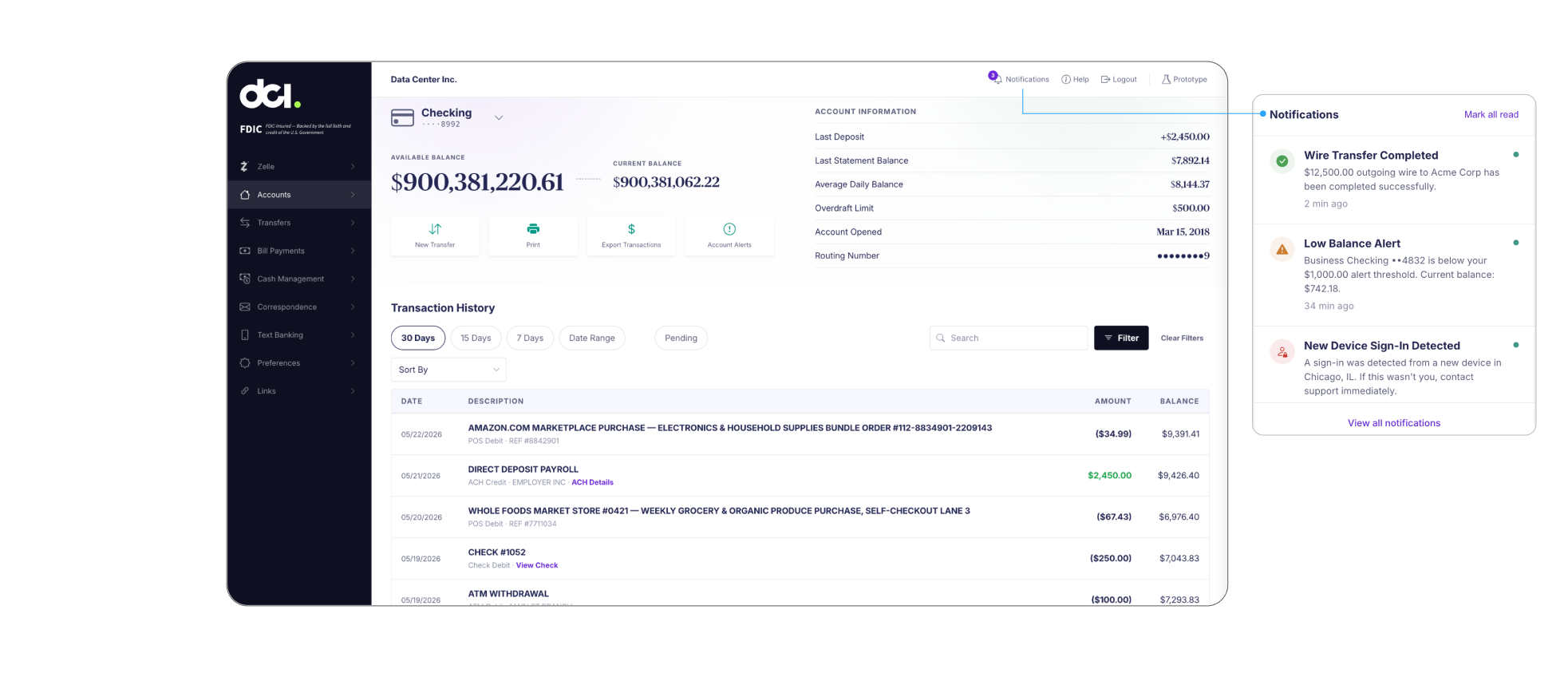
Checking Account Transactions
Checking Account Transactions
Checking Account Transactions
Checking Account Transactions
Checking Account Transactions
AI-powered design system library
AI-powered design system library
AI-powered design system library
AI-powered design system library
AI-powered design system library
The library pairs every component with the rule for using it, generated from the team's design decisions.
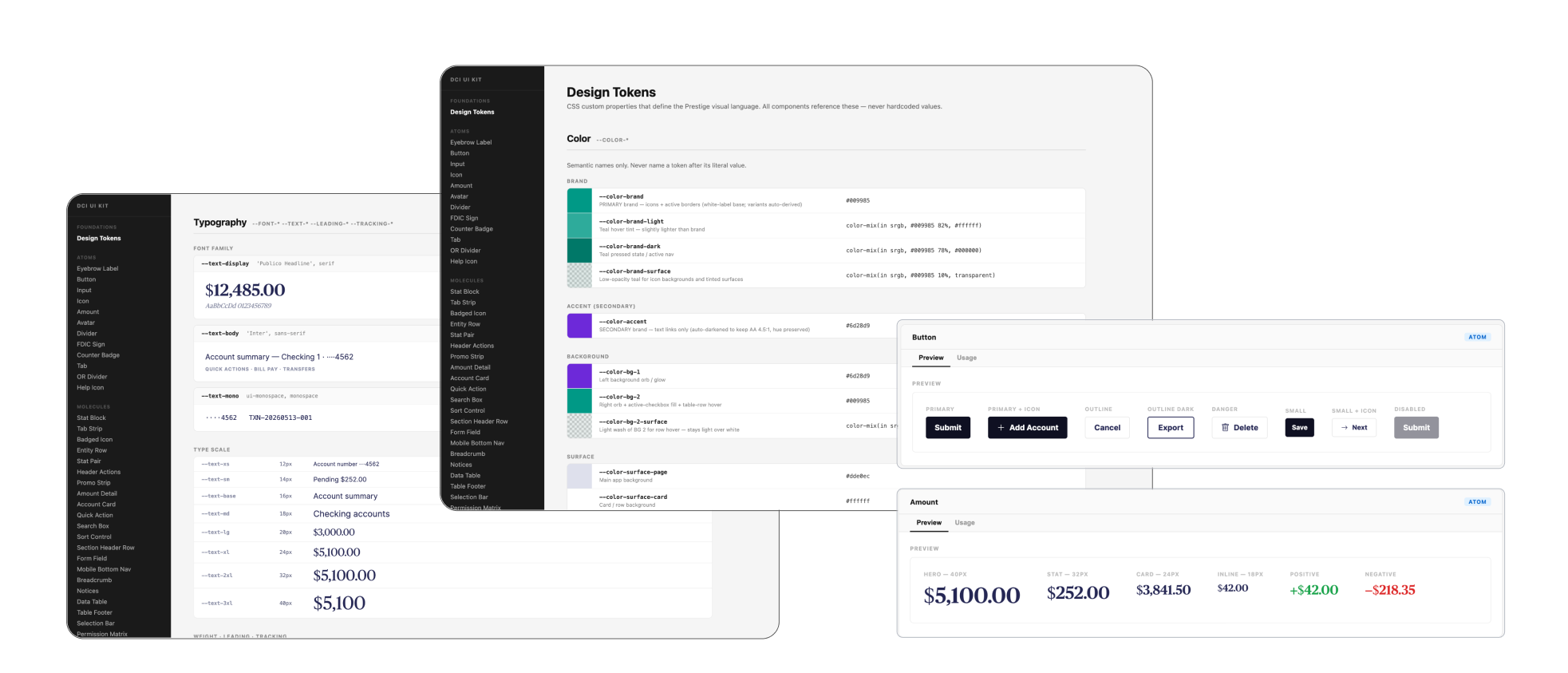
Example component spec: primary button
Example component spec: primary button
Example component spec: primary button
Example component spec: primary button
Example component spec: primary button
Use one primary button per view, for the single most important action. All other actions use secondary or ghost styles. Minimum height 44px, placed at the end of the reading path.
Usage guidance ships with every component, so a designer or an AI agent applies it the same way each time. This is what turns 41 components into a system.
Praxent delivered a repeatable AI-driven modernization process [i]DCI could continue using.[/i]
Praxent delivered a repeatable AI-driven modernization process [i]DCI could continue using.[/i]
Praxent delivered a repeatable AI-driven modernization process [i]DCI could continue using.[/i]
Praxent delivered a repeatable AI-driven modernization process [i]DCI could continue using.[/i]
Praxent delivered a repeatable AI-driven modernization process [i]DCI could continue using.[/i]
Modern Build
Modern Build
Modern Build
Modern Build
Modern Build
2 end-to-end features rebuilt on .NET 10 and Vue 3, shipped as 25 pull requests across 4 repositories: API, UI, component library, and AI skills.
Product Prototype
Product Prototype
Product Prototype
Product Prototype
Product Prototype
A 19-page interactive prototype showing Account Summary and Checking Account Transactions workflows.
Design System
Design System
Design System
Design System
Design System
41 reusable components, design tokens, templates, and style guidance for future product development.
Governed AI Workflow
Governed AI Workflow
Governed AI Workflow
Governed AI Workflow
Governed AI Workflow
An on-premises, spec-first workflow from legacy source to test-gated PR, with rule-level traceability and a human review gate.
Enablement Assets
Enablement Assets
Enablement Assets
Enablement Assets
Enablement Assets
Feature migration workflow, Azure DevOps AI skills, and a playbook committed to the codebase, so DCI engineers run the process themselves.
Praxent delivered not only modern banking features but uplevelled the team's AI processes to enable [i]continuous innovation.[/i]
Praxent delivered not only modern banking features but uplevelled the team's AI processes to enable [i]continuous innovation.[/i]
Praxent delivered not only modern banking features but uplevelled the team's AI processes to enable [i]continuous innovation.[/i]
Praxent delivered not only modern banking features but uplevelled the team's AI processes to enable [i]continuous innovation.[/i]
Praxent delivered not only modern banking features but uplevelled the team's AI processes to enable [i]continuous innovation.[/i]
Agentic design-to-engineering gap closed
Agentic design-to-engineering gap closed
Agentic design-to-engineering gap closed
Agentic design-to-engineering gap closed
Agentic design-to-engineering gap closed
Designers handed engineers production code, removing the rebuild step and reducing design QA to near zero.
Time redirected to quality
Time redirected to quality
Time redirected to quality
Time redirected to quality
Time redirected to quality
With repetitive translation work removed, developers focused on performance, security, accessibility, and product quality.
AI trust through human review
AI trust through human review
AI trust through human review
AI trust through human review
AI trust through human review
Human-in-the-loop review gave DCI confidence that AI-generated output met their quality bar.
2x the planned scope
2x the planned scope
2x the planned scope
2x the planned scope
2x the planned scope
Scoped to prove a single vertical slice. Praxent delivered two complete end-to-end banking features.
Repeatable AI-modernization
Repeatable AI-modernization
Repeatable AI-modernization
Repeatable AI-modernization
Repeatable AI-modernization
An agentic workflow DCI adopted during the engagement, proven across two production features and ready to scale across the platform.
Reusable foundations delivered
Reusable foundations delivered
Reusable foundations delivered
Reusable foundations delivered
Reusable foundations delivered
A 19-page prototype and a 41-component design system to build on for future product work.
The marker we look for is a team that stops reviewing our work and starts running it themselves. On DCI, their own engineers picked up the workflow before we finished and made it part of how they build.
The project became a catalyst for broader modernization and [i]a repeatable capability to build on.[/i]
The project became a catalyst for broader modernization and [i]a repeatable capability to build on.[/i]
The project became a catalyst for broader modernization and [i]a repeatable capability to build on.[/i]
The project became a catalyst for broader modernization and [i]a repeatable capability to build on.[/i]
The project became a catalyst for broader modernization and [i]a repeatable capability to build on.[/i]
Platform-Wide AI Modernization
Platform-Wide AI Modernization
Platform-Wide AI Modernization
Platform-Wide AI Modernization
Platform-Wide AI Modernization
With the workflow proven on two features, it can be extended across the rest of GoBanking, with broader rollout underway.
In-House Capability
In-House Capability
In-House Capability
In-House Capability
In-House Capability
DCI's engineers can lead AI-assisted, spec-first delivery in-house, building the team's capacity for the work ahead.
AI Readiness Beyond Engineering
AI Readiness Beyond Engineering
AI Readiness Beyond Engineering
AI Readiness Beyond Engineering
AI Readiness Beyond Engineering
Governance, documentation, and reusable workflows give DCI a foundation for AI initiatives across the organization.
Agentic Development
Agentic Development
Agentic Development
Agentic Development
Agentic Development
AI is a dependable part of the build process. Structured specifications give engineers a reliable way to apply it to new work.
Working with Praxent has been a great learning experience for DCI. It’s been highly beneficial, pushed our team to think beyond our status quo, and helped drive AI adoption from about 20 engineers to 56 today.